Vinyl Pressing Steps in 2026
Vinyl records are back — and in 2026, they remain the go-to physical format for electronic music lovers and underground culture enthusiasts. But what actually happens between an audio file and a groove pressed into wax?
The vinyl pressing process has barely changed in decades, blending precision engineering with genuine craftsmanship. From lacquer cutting to final pressing, here's your complete, up-to-date guide to manufacturing your own records in 2026.
🎵 1. Pre-Production: Getting Your Release Ready
- Audio Master Preparation
The vinyl production process begins with preparing a proper audio master. For electronic music especially, a high-quality master optimized specifically for vinyl is non-negotiable. Vinyl mastering differs significantly from digital mastering: low frequencies need careful management to prevent distortion, and volume levels must be calibrated so grooves don't cut too wide, which would reduce the playback time per side. Properly organizing and naming your audio files before upload is essential to avoid costly errors or side inversions.
- Label, Sleeve & Artwork Creation
Designing your center label and sleeve (optional) is a key step in defining your vinyl's identity. You'll need to supply the pressing plant with a print-ready PDF file. Most manufacturers provide a template with specific format, margin and bleed requirements, though templates are also widely available online. Always work at a minimum resolution of 300 DPI for sharp, professional results.
- SDRM Declaration (France)
In France, an SDRM declaration is mandatory for any vinyl manufacturing run, even for artists not registered with SACEM. In that case, the mechanical royalty fee is calculated at €0, but the application is still required. Once approved, you'll receive an SDRM number that must be submitted to the pressing plant before production can begin.
🏭 2. Inside the Pressing Plant: How It All Works
- Choosing Your Pressing Plant
There's no shortage of pressing options out there, but genuinely reliable, professional plants are rarer than they appear. Price alone should never drive your decision: factor in lead times, shipping options, and the quality of their customer service. Don't hesitate to reach out to us — we're happy to point you toward trusted pressing partners.
- Step 1: Cutting the Lacquer
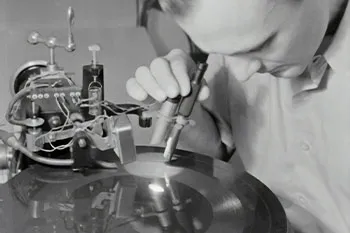
Once the audio master is ready, it's sent to the pressing plant where it gets transferred onto a lacquer disc — a metal disc coated with a thin layer of nitrocellulose. A lathe fitted with a heated stylus cuts the grooves directly into the lacquer surface, creating a negative image of the final record. This stage demands extreme precision: every nuance of the audio must be captured faithfully in the groove.
- Step 2: Electroplating
Electroplating is an electrochemical process at the heart of stamper production for vinyl pressing. A thin layer of metal, typically nickel, is deposited over the lacquer master, faithfully replicating every groove. The result is a durable metal copy called a stamper, capable of pressing thousands of high-quality vinyl records while maintaining consistent, faithful sound reproduction.
A note on terminology: The terms "matrix", "master" and "stamper" are often used interchangeably but refer to distinct things. Here's a breakdown of what each means in the vinyl pressing chain.
The vinyl pressing step is where everything comes together. This is the moment the music physically takes shape on its final medium. The video below gives a concrete look at the vinyl pressing process, from stamper to finished record.
-
1. The Master
The master is the very first version of the record, cut directly from the original audio recording onto an acetate disc — a notoriously fragile material. It holds the grooves that represent the music and serves as the starting point for all subsequent stages. This is a one-of-a-kind original: too delicate to use directly for pressing and not meant to be played repeatedly.
-
2. The Matrix
The term "matrix" covers several stages in the process, so it's worth distinguishing between them:
Original matrix (or "mother"): The first metal copy of the master, produced by electroplating. It's a negative impression, with grooves in relief.
Pressing matrices (or "stampers"): Metal copies derived from the mother, also made by electroplating. These are positive impressions, with grooves recessed, and are what physically press the vinyl records.
The mother is used to produce the stampers; the stampers press the discs. Matrices are more robust than the original master, and stampers are engineered specifically to withstand the repeated stresses of production. -
3. The Stamper
The stamper is the pressing matrix — the metal copy derived from the mother that is used to physically press vinyl records. It transfers the groove pattern from the master onto each disc. It's the most hardwearing element in the chain, built to handle the pressures of mass production and deliver consistent results across thousands of copies.
- Step 3: Pressing the Vinyl
The stamper is loaded into a hydraulic vinyl press, where molten PVC (polyvinyl chloride) is injected under high pressure. The PVC takes on the exact shape of the stamper, forming the record with all its characteristic grooves. This step is critical: the quality of the press directly determines the sonic quality of the finished disc. A poorly executed pressing can introduce surface noise, skips, or compromised audio reproduction.
- Step 4: Cooling & Trimming
After pressing, the disc is cooled to solidify the PVC. The edges are then trimmed to achieve the final circular shape, and the center hole is punched out. At this point, each record undergoes a visual inspection to catch any surface defects. Discs that don't pass are set aside; those that do move on to labeling.
- Step 5: Labeling & Packaging
Labels are applied to both sides of the disc, carrying the artist name, track titles, and any other relevant release details. The record is then slipped into an inner paper sleeve for scratch protection before being inserted into the printed outer sleeve. The outer sleeve typically features the artwork, along with additional release information.
- Step 6: Quality Control
Before shipping, records go through a quality control process — the rigor of which varies considerably between plants. Sample copies are played back on a turntable to verify playback performance and confirm the audio matches the original master. Any disc that doesn't meet the standard is replaced. In theory, this final step ensures that only the best pressings reach your hands.
- Shipping
Finally, records are packed and dispatched to distributors or directly to customers. The vinyl pressing process is complex and demands close attention to detail at every stage to guarantee a high-quality end product. From experience, we strongly advise against pallet deliveries. Standard courier shipping via UPS or similar carriers is faster, and it eliminates the risks that come with pallet handling, sun exposure, or improper storage. Worth discussing directly with your pressing plant. On delivery, carefully inspect every box before signing off. Once you've accepted the shipment, pull a random disc from each carton and check it's perfectly flat. Any defect spotted — warping, scratches, pressing issues — contact the after-sales team straight away.
2026 Update: Many pressing plants now offer Bio-Vinyl (PVC-free) or recycled PVC granule options. These choices meaningfully cut the carbon footprint of your pressing run without touching sound quality.
Important: To prevent warping, vinyl records must always be stored upright — never flat. Stacking them horizontally causes the weight to build up on the bottom discs, which can lead to permanent deformation. Use dedicated record crates or keep them standing in their original shipping boxes.
To accurately estimate the cost of producing a vinyl record, every line item in your vinyl pressing project needs to be accounted for:
- The center label design, meaning the artwork for the disc's printed inner label.
- Vinyl mastering, specifically optimized for the format to ensure high-quality audio reproduction.
- Artist fees, along with any applicable publishing or neighboring rights costs.
- Shipping and distribution costs for getting your pressed records where they need to go.
Factor all of these in and you'll have a clear picture of the total cost of your vinyl pressing — and a solid budget framework for your release.
From the pressing plant to your turntable
Every record we sell has been through these steps. Check out our latest vinyl arrivals, our techno vinyl selection and our hardtek and tribe records.
FAQ - Vinyl Pressing
What are the main steps in the vinyl pressing process? ↓
Vinyl pressing involves 6 core stages: (1) cutting the master onto lacquer or DMM, (2) electroforming (electroplating) to create the stampers, (3) pressing the disc from hot PVC under high pressure, (4) cooling and trimming, (5) labeling and sleeving, and (6) quality control with listening tests.
How long does vinyl pressing take at a plant? ↓
In 2026, the average lead time for vinyl pressing in France or Europe runs between 6 and 8 weeks, covering stamper production, the pressing run itself, quality testing, and packaging. Timelines vary depending on the plant and the time of year.
How much does vinyl pressing cost? ↓
Vinyl pressing costs depend on the run size and the options selected. For a standard run of 300 black 12-inch records, budget roughly €2,000 to €2,500 all-in (mastering, stamper creation, pressing, basic labels and sleeves), before external mastering fees, graphic design, and distribution costs. Coloured vinyl or premium sleeve options typically add 15 to 30% on top.
Where can you press vinyl records in France and Europe? ↓
The right plant depends on your timeline, budget, quality expectations, and any special requirements like coloured vinyl, picture discs, and so on. For techno and hardtek labels, feel free to get in touch — we've tested several plants ourselves and we're happy to point you toward the reliable ones. Trust us, choosing the right pressing plant is one of the most important decisions in the whole process.
What is the minimum quantity for a vinyl pressing run? ↓
Minimum order quantities vary by plant, generally falling between 100 and 300 copies. For techno and hardtek labels or independent artists, 300 copies is the most common starting point — it's a realistic way to test the market while keeping the per-unit cost manageable. Some plants offer short runs from 100 copies, though usually at a higher unit price.
Can you press coloured vinyl for techno releases? ↓
Absolutely — coloured, splatter, transparent, and picture disc pressings are very much possible and hugely popular in the techno and hardtek scene. These visual editions make for compelling limited releases that collectors go for. One thing to keep in mind: coloured vinyl adds 15 to 30% to production costs and can slightly affect audio quality compared to standard black vinyl.