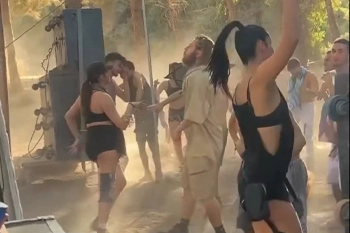
Free Party: Music, Movement & Culture
At the heart of the free party experience, electronic music reigns supreme. More than a backdrop, it's the very soul of these fleeting gatherings, delivered by sound systems of uncompromising power and quality. These events — known as rave parties, teufs, or teknivals when multiple sound systems converge — are inseparable from the frequencies and rhythms that drive them. While techno is the umbrella term most often used to describe the music, it actually covers a sprawling mosaic of subgenres — Tribe, Hardcore, Acid, and beyond.
Free parties, beyond the myth
When people think of a free party, they picture a muddy field, a wall of speakers, and a crowd lost in a trance until sunrise. And sure, that's part of it. But behind the raw scenery lies a genuine musical culture — a rich, living scene built above all on one principle: freedom.
No overhyped lineups, no overpriced tickets, no barrier between artists and crowd. The free party puts electronic music back at the centre of everything, in its most direct and instinctive form, blasted through walls of sound that hit you in the chest before you even find your footing.
This article sets the clichés aside and goes straight to the core of the movement: its distinctive sound, its hybrid genres, its DIY ethos, and the people who keep the sound systems alive every weekend, in fields and warehouses far off the beaten path.
An underground sonic legacy
To understand free party music, you have to go back to the roots — to the early 90s UK rave scene, where it all starts. Collectives like Spiral Tribe crossed the Channel and laid the groundwork for the travelling sound system concept. That's the origin point of underground techno in Europe.
In France, the first free parties landed shortly after — often thrown together on the fly, but driven by a real desire to push both musical and social boundaries. Quickly, the sounds took on their own identity, styles began to cross-pollinate, and something distinctly French emerged: tribe, hardtek, acidcore — genres entirely their own.
Some of the legendary tribes from the 90s that shaped the scene: Fox Tanz, Metek, Facom Unit, Tnt, Tomahawk, Teknokrates, Sound Conspiracy, and many more.
Artists made their own music — often in their bedrooms, with salvaged gear or cracked software, building their live machine sets from scratch. The motto: total independence. No label, no studio, just creation on the margins, at the pace of ideas, friendships, and speaker stacks.
And what did that produce? A raw, unfiltered sound — often deeply personal, sometimes experimental. Music built for the wall of speakers, for movement, for bodies in motion. Music that doesn't try to please everyone, but speaks directly to those who surrender to it completely: standing in a field at 3am, feet in the dirt, head deep in the bass.
The styles that move the sound systems
At a free party, music isn't background noise — it's the engine of the night. And the styles you'll encounter are as varied as they are intense. Forget "lounge" techno or the polished sets you get in clubs. This is where things get hard, fast, and feral.
The most emblematic genre? Hardtek — massive kicks, driving bass, built to make an entire dancefloor jump at 160 BPM.
Then there's mental tribe and acidcore: darker, more repetitive, more cerebral — sounds that burrow into your head and don't let go.
And if you're into extremes, you're covered: hardcore, frenchcore, breakcore, speedcore — anything goes at a free party. Some collectives venture into electro, dub, jungle, even ambient territory, depending on the hour and the vibe.
Every style has its own codes, textures, and BPM range. But they all share one thing: raw energy, a refusal to conform, and a collective drive to move a crowd in ways that nowhere else quite manages.
Whether you're discovering the free party sound for the first time or hunting for tracks for your next set, check out our playlists:






The free party musical experience
At a free party, you don't just listen to music — you live inside it. It's a total physical experience, where every frequency moves through your body and every kick lands somewhere deep in your gut. And that's all down to one central element: the sound system.
These walls of speakers — handbuilt in the early days, increasingly large and professional today — are engineered to deliver sound that's powerful, precise, and far more immersive than anything you'd find in a club. Crews spend hours tuning their rigs through the night, chasing the best possible sound quality, even in the middle of a field.
Behind the decks and machines, you'll find DJs and live acts. Some deliver surgically precise sets; others improvise in real time with hardware, no laptop, pure instinct. The live machine set is an art form in its own right within free party culture.
And the crowd? They're not just dancing. Some go 10, 15 hours straight — alone or with their crew — locked into a kind of collective trance. Music becomes a bond, an endless loop, a universal language. You don't need words when the kick hits everyone at the same time.
A free party isn't just a night out. It's a moment outside of time, carried by a shared vibration between the sound, the people, and the instant itself.
Making music for the free scene
Producing music for the free party scene has nothing to do with big studios or expensive gear. This is about free, spontaneous, largely self-taught creation. Most artists make their tracks at home, on a corner of a desk, with an old PC or no computer at all, a few machines, and a serious amount of passion.
On the tools side, you'll find FL Studio and Ableton Live, but also drum machines, hardware sequencers, analog synths, and modular setups. The gear doesn't matter — what matters is the sound you pull out of it.
Some of the scene's key artists to know: Fky, Boucles Etranges, 69DB, Crystal Distortion, and many more.
Many artists share their music on Soundcloud, or press small runs of vinyl in very limited quantities. Some don't put anything online at all — their live sets are one-shot moments, there to be experienced in person or not at all.
Alongside live sets, vinyl DJ sets are central to these events — and increasingly, controller sets too. In the free party world, the DJ set becomes the backbone of the night, where every transition and every drop reflects a collective energy. Mixing on vinyl carries a particular authenticity — a direct connection between the artist, the craft of mixing, and the crowd.
There's also a whole alternative ecosystem of free party labels: collectives like Okupe, Tikal Sound Records, Peur Bleue, and our own label Vinylbleu, whose releases you can find right here on the site.
Making music for the teuf is more than a style — it's a stance. The drive to build something that sounds like you, that makes you feel something, and that, if you're lucky, will have arms in the air at 4am in the middle of nowhere.
FAQ — Free party music, 4 questions
What's the difference between a free party and a rave? ↓
A rave can be legal, sponsored, and properly permitted. A free party is typically unsanctioned, self-organised, free or pay-what-you-can. Musically they share roots, but the free party scene pushes further into sonic experimentation and total independence.
Why is the sound so loud? ↓
No louder than a festival — but the whole point of a free party sound system is to be felt as much as heard. Crews build their own rigs so the bass hits hard, the highs cut through the air, and every note moves you from head to toe.
Is there improvisation in live sets? ↓
Absolutely — and that's exactly what makes free party live sets unique. Many artists perform in live machine mode: chaining patterns and sounds in real time, pure in-the-moment creation, driven entirely by feel.
Can you produce free party music on a tight budget? ↓
Absolutely. You can start with a laptop, a DAW, a handful of samples, and a lot of listening. What matters most is the drive, the ideas, and above all, an ear for the dancefloor.
Old School Mixtape 97

🎧 Numéro Bleu
Explore the techno and hardtek universe of Numéro Bleu — an artist at the crossroads of the free party scene and broader electronic influences.
Discover the artist