Vinyl Cutting: The Art and Technique of the Cutter
A deep dive into the precision craft that turns sound into matter.
Vinyl has never been more alive. After coming dangerously close to extinction in the early 2000s, the analog format is experiencing a spectacular revival. But behind every record you drop on your turntable lies an incredibly refined, almost mystical skill set: vinyl cutting.
This is the moment where an intangible audio file becomes a physical object. We're not talking about copying — we're talking about sculpting sound. One thing to keep straight: cutting is not pressing. It's the very first step, the one that makes pressing possible at all.
A high-precision craft
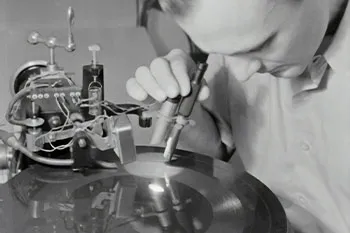
The cutting engineer works with a lathe fitted with a diamond stylus, carving microscopic grooves into a blank lacquer disc. Every vibration in the audio signal becomes a physical undulation that your playback needle will later read and interpret.
It's a rare trade. Legendary machines like the Neumann VMS 70 and VMS 80 haven't been manufactured since the '80s, and keeping them running demands an almost obsessive level of mechanical and electronic expertise. The result: fewer than a hundred active cutting engineers exist worldwide.
Vinyl-specific mastering: knowing the rules of the format
You can't cut a digital file as-is. Vinyl comes with physical constraints that digital simply doesn't have to deal with. Here's why vinyl mastering is a discipline of its own:
- Mono bass: Below 150–200 Hz, low frequencies must be summed to mono. Stereo bass causes the groove to oscillate so wildly the needle skips right out.
- Sibilance control: Sharp "S" and "SH" sounds generate high-frequency peaks that can make a groove literally impossible to cut cleanly.
Then there's the famous RIAA curve: highs are boosted and lows are cut during the cutting process, and your phono preamp applies the exact inverse on playback, bringing the frequency response back into balance while keeping surface noise in check.
How a groove is born: thermodynamics and precision
For the diamond to cut cleanly, the lacquer is heated to around 45°C (113°F). The material softens just enough for the stylus to carve without tearing. Meanwhile, a vacuum system continuously removes the "chip" — the fine thread of nitrocellulose shaved off during cutting.
Lacquer vs DMM:
Lacquer cutting remains the most traditional method, valued for its warm, organic sound. Direct Metal Mastering (DMM), cut directly onto copper, is the go-to for audiophile pressings thanks to its extended dynamic range and reduced noise floor.
How a vinyl record is made: from sound wave to groove
Vinyl manufacturing is a complex industrial process that transforms a digital audio master into a physical object. It combines precision engineering with hands-on craftsmanship, moving from the cutting of a master lacquer all the way to pressing thousands of identical copies.
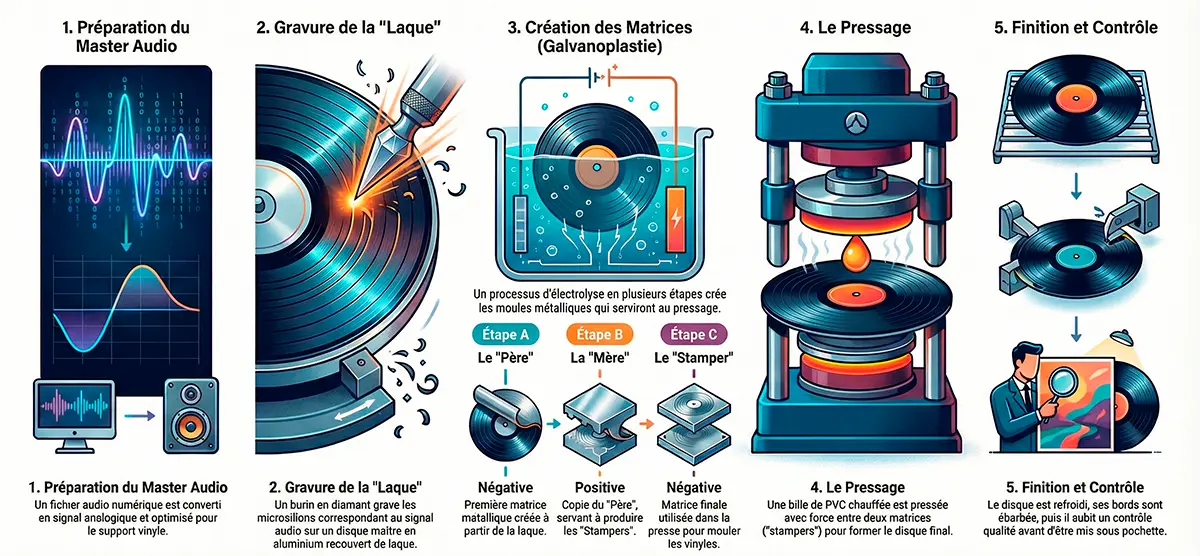
A single stamper can press between 1,000 and 1,500 records before wearing out. For larger runs, multiple stampers are needed to maintain consistent quality throughout the production.
FAQ — Vinyl cutting
What's the difference between vinyl cutting and vinyl pressing? ↓
Vinyl cutting — also called lacquer cutting — is the step where an audio signal is physically translated into a microgroove on a lacquer disc or DMM copper plate. It's an extremely high-precision operation carried out by a cutting engineer using a specialized lathe (such as the Neumann VMS series).
Pressing comes after: it's the mechanical process of reproducing that groove across hundreds or thousands of final vinyl records. Without a quality cut, even the best pressing plant in the world can't save the sound.
Why does the cut have such a big impact on vinyl sound quality? ↓
Because everything the cartridge picks up during playback depends directly on how the groove was cut. The cutting engineer fine-tunes the dynamics, groove width, low-frequency handling, and overall level to prevent distortion and energy loss.
In electronic music genres like techno or hardtek, where the kick drum pushes the groove to its physical limits, a well-executed cut makes a night-and-day difference on the dancefloor and in the listening room alike.
Are all vinyl records cut the same way? ↓
Not at all. The two main approaches — lacquer cutting and DMM (Direct Metal Mastering) — each have their own sonic character and technical strengths. Beyond the medium itself, the cutting engineer's experience, the upstream mastering, and the time spent on the session all shape the final result.
That's why two pressings of the exact same track can sound radically different depending on the choices made at the cutting stage.
After cutting: the pressing stage
The cut creates the one-of-a-kind original from which every copy will be derived. Where cutting is artisanal and unrepeatable, industrial pressing is what scales the music out into the world.
To get from lacquer to finished record, metal stampers are electroformed from the master and mounted onto the presses. This is the step that turns an artistic intention into a collectible object.
Complete 2026 guide: vinyl pressing step by stepWhy the cut defines the sound
A great pressing starts with a great cut. An experienced cutting engineer knows exactly how hard to push the level — maximising signal without overloading the groove. That's what gives you those deep, round lows and crisp, open highs, without the harshness you sometimes get from digital.