Vinyl Records: Why Do They Appeal? How Do They Endure?
For every music lover, regardless of genre, vinyl is the equivalent of fine dining. The vinyl record, also known as a "microgroove disc," was the dominant commercial audio format throughout the second half of the 20th century. It delivers a listening experience defined by warmth, depth, and a sonic richness no streaming platform can fully replicate. But where does vinyl stand today? Is it still thriving? How has it carved out a place in modern DJ culture and mixing? And how did it all begin? Let's break it down.
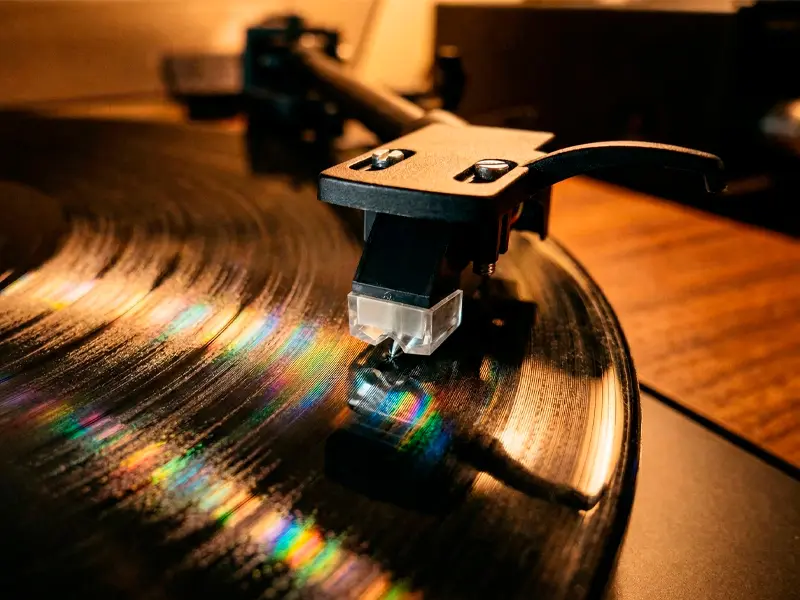
How does a vinyl record work?
Vinyl originally refers to a common plastic material (polyvinyl chloride). Today the word is synonymous with the vinyl record itself, a music playback format that spans every genre imaginable. Like a CD, a vinyl record has two sides. Classically pressed in black, it now comes in an ever-growing range of colors, splatter patterns, and picture disc editions. A vinyl record can only be played on a turntable or record player.
Playback works through a diamond-tipped stylus that traces the microgroove carved into the disc surface. As the needle rides those tiny grooves, it vibrates and generates a mechanical signal that travels through the tonearm and gets converted into sound.
From groove to speaker: the role of the phono cartridge
The real magic happens at the end of the tonearm. As the diamond stylus traces the microgroove's undulations, it transmits ultra-precise mechanical vibrations to the phono cartridge. Inside, a tiny magnet moves between copper coils and that motion generates a very low-level electrical signal.
That signal then passes through a phono preamp, which restores the deep bass and crisp highs before they reach your speakers. A fully physical, entirely analogue chain, not a single byte involved, which is exactly why vinyl carries that distinctive warmth no digital format has managed to replicate.
Frequencies, sound waves, analogue vs digital: if you want to understand why this chain sounds so different from an MP3 or a stream, we break it all down in our article on the physics of sound .
What is a microgroove record?
The microgroove is literally the path the stylus follows. Pressed in a spiral across the entire surface of the disc, this groove is so fine, just 0.025 mm wide, that to the naked eye it reads only as a sheen. That precision changes everything: where an old 78 rpm disc could hold no more than 5 minutes per side, the microgroove format introduced in 1948 made it possible to store up to 45 minutes of music on a single record. A quiet revolution, pressed into plastic.
Vinyl formats: 33, 45, 78 and 16 rpm
RPM simply stands for revolutions per minute, the speed at which the record spins. And that number changes everything: size, playing time, and intended use.
● The 78 rpm (1920–1950)
25 to 30 cm in diameter, 3 to 5 minutes per side — enough for one or two tracks. Production ceased in the 1950s, but original pressings remain highly sought after by collectors.
● The 33 rpm (LP / album)
33⅓ revolutions per minute, 30 cm in diameter. The definitive album format, holding 8 to 12 tracks in total. In its 17 cm version it becomes an EP, typically around 4 tracks.
● The 45 rpm (single / maxi)
17 cm, one or two tracks per side. The forerunner of the CD single. Some 30 cm maxi-singles offered extended cuts of 5 to 20 minutes, a staple of disco and funk.
● The 16 rpm (spoken word)
Introduced in 1957, used almost exclusively for audiobooks and theatre recordings. It never found a wide audience and quietly disappeared within a few years.
A brief history of vinyl
How and why did the vinyl record and the turntable come to exist? At every stage of its evolution, vinyl mirrors a chapter in social history and the shifting tastes that came with it. Every genre has had its moment pressed into wax: jazz, classical, rock, hip-hop, and today electronic music. A true icon of pop culture, vinyl has been captivating listeners for generations and shows no sign of stopping.
The earliest version of a record-playing device was developed in France in 1857 by Édouard-Léon Scott de Martinville, the inventor of the phonautograph. At the time it captured sound as a visual trace rather than playing it back. Thomas Edison picked up the baton in 1877, building a new machine that could both record and reproduce audio: the turntable was born. Alexander Graham Bell then refined the concept further, combining beeswax with the stylus to better capture sound waves and giving rise to the gramophone.
A decade later, Emile Berliner patented his own version, built from hard rubber and shellac. His machine could read the grooves of flat discs rather than cylinders, and with that shift the vinyl record as we know it began to take shape.
What is a vinyl record made of?
Vinyl is first and foremost a plastic material: polyvinyl chloride, or PVC. Flexible, lightweight, and durable, it gives the record its characteristic suppleness while standing up to stylus contact, repeated handling, and the passage of decades. The classic black colour comes simply from carbon black added during pressing to stiffen the disc.
Coloured vinyl? Same process, with added pigments. The results are visually stunning and sound quality is unaffected. Each record is hot-pressed in around thirty seconds between two metal stampers — a process that is almost artisanal in its precision despite being industrial in scale, and one that has changed remarkably little since the 1950s.
Vinyl and music: a story of every genre
The golden age of the turntable and the vinyl record spans the 1960s and 70s, a period defined by dramatic leaps in sound quality that drove its commercial success. From the 80s onward, hip-hop DJs began reimagining what the format could do — using mixers to layer rhythmic elements, adding cuts and scratches in real time. Scratching took off and never looked back.
Vinyl has carried every genre imaginable: classical, jazz, hip-hop, disco, electronic. The turntable itself became an object of desire, part furniture, part instrument, part collector's piece. While in the 1970s it was one of the only ways to listen to music at home, today it occupies a very different space — a mid-to-high-end lifestyle object at the heart of a dedicated community of diggers and crate hunters.
Listening to vinyl is a different kind of experience. It demands attention in a way that earbuds on a commute never will. Picture a warm room, good speakers, the ritual of dropping the needle — total immersion in the music. Presence over distraction.
The vinyl revival
After years sustained largely by underground scenes — acid, hardcore, tekno, and other niche genres — vinyl has made an undeniable return to the mainstream. Major retailers stock it alongside specialist shops and online stores, and leading artists now regularly issue their albums as LP editions, inviting listeners into the full vinyl experience.
Turntable production has followed suit, with a new generation of players that pair audiophile performance with modern convenience: music lovers across every genre now enjoy high-fidelity playback alongside features like USB recording, and Bluetooth connectivity to smartphones, tablets, and computers.
A genuine cultural comeback, at a moment when many had written the format off in the face of internet downloads and streaming. Vinyl today is both a collector's object and a premium listening medium — something people feel a real emotional connection to, like treasure tracked down through record fairs, second-hand shops, and small-run pressings that rarely make it into mainstream distribution.
Frequently asked questions about vinyl records
How does a vinyl record work? ↓
A diamond-tipped stylus mounted on the tonearm traces the spiral groove pressed into the disc. As it travels those grooves it vibrates, and those vibrations are amplified into sound. Entirely mechanical, entirely analogue — not a single byte involved.
What is a microgroove record? ↓
It is the technical name for modern vinyl records — 33 and 45 rpm — introduced in 1948. The groove is so fine, just 0.025 mm wide, that a single disc can hold up to 45 minutes of music where an old 78 rpm could barely manage 5 minutes per side.
What is a vinyl record made of? ↓
PVC — polyvinyl chloride. A flexible, resilient plastic that holds up remarkably well over the years. The classic black colour comes from carbon black added during pressing. Coloured vinyl uses the same PVC with pigments mixed in.
What is the difference between a 33 rpm and a 45 rpm? ↓
The 33 rpm (30 cm) is the LP format: 8 to 12 tracks, up to 45 minutes of music. The 45 rpm (17 cm) is the single format: one or two tracks per side. The names simply reflect the speed at which each disc spins.
How many songs fit on a vinyl record? ↓
On a 33 rpm LP, typically 8 to 12 tracks in total — 4 to 6 per side, around 20 to 25 minutes each. On a 45 rpm single, usually one track per side. The louder a track is mastered, the wider the groove it needs, which leaves less room on the disc overall.
Why is vinyl making a comeback? ↓
Because people grew tired of listening to music on autopilot. Vinyl demands a ritual: dropping the needle, flipping the record, reading the sleeve. It is intentional, warm, and tangible in a way streaming will never be. And that feeling never really goes out of style.
Shop vinyl records on Vinylbleu
Looking to grow your collection? Vinylbleu stocks a carefully selected range of techno, hardtek, and tribe vinyl — new and second-hand.
Our 17th release is now available: