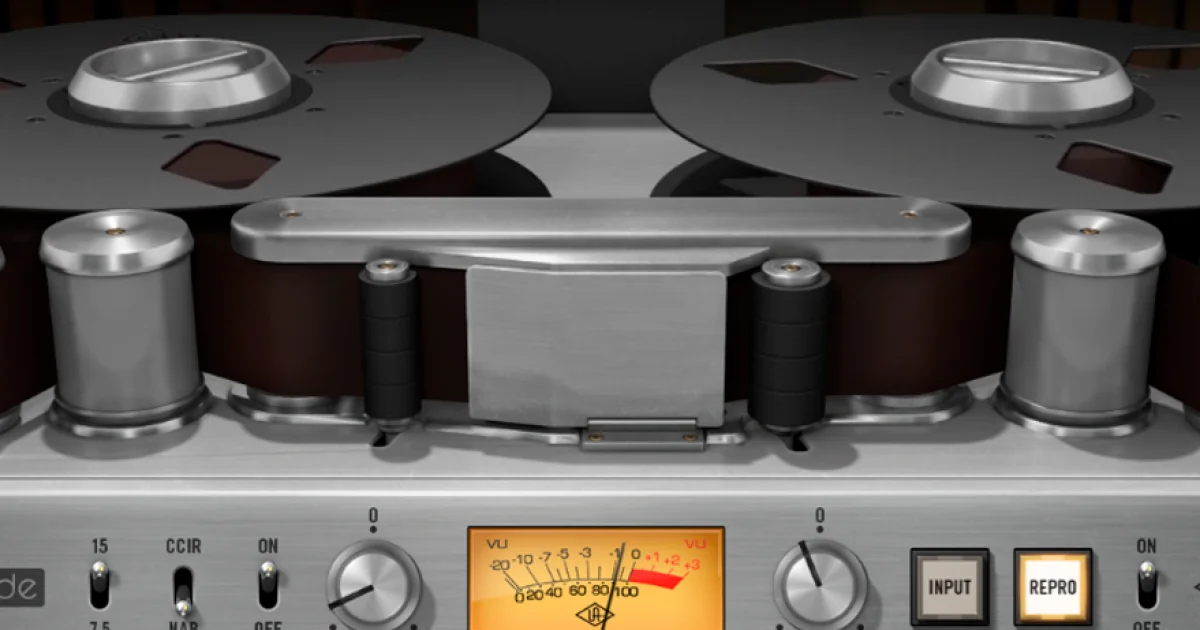
Vinyl is physics: frequencies, waves and analog warmth
Sound, before it becomes an emotion, is physics. A disturbance in the air, a vibration, a wave travelling through space. On a vinyl record, that wave is literally carved into the material itself. Understanding how sound actually works is understanding why your record sounds different from an audio file — and why that difference is anything but imaginary.
What is a sound wave?
Sound doesn't exist in a vacuum. It's a pressure variation propagating through a medium — air, water, wood... When something vibrates, a speaker, a guitar string, a kick drum, it compresses and releases the surrounding air molecules. Those compressions travel in chain, like ripples on water, until they reach your eardrums.
Two parameters entirely define a sound wave: its frequency and its amplitude. Everything else follows from there.
Frequency: low or high?
Frequency measures the number of vibrations per second, expressed in Hertz (Hz). The higher the frequency, the higher the pitch.
The human ear can theoretically perceive frequencies between 20 Hz and 20,000 Hz — though that range tends to narrow with age and years of late nights on the dancefloor. The kick in a techno track or any electronic music lives between 60 and 80 Hz: it's physical, something you feel in your chest before it ever reaches your ears.
Amplitude: loud or quiet?
Amplitude measures the force of the vibration — in other words, the perceived volume. It's expressed in decibels (dB). Normal conversation sits around 60 dB, a live concert around 110 dB, an outdoor sound system at 120 dB and beyond. Every 10 dB increase represents a tenfold increase in sound power. The scale isn't linear, it's logarithmic — which is exactly why turning the volume up one notch never seems to do much.
In short: frequency determines what you hear (low or high pitch), amplitude determines how loud. Together, these two dimensions can describe any sound that exists.
From acoustics to groove: the journey of a signal
Here's something most people never picture: when a sound is recorded and cut to vinyl, it makes a full round trip between the acoustic world (air, vibrations) and the physical world (matter, grooves). Every step along the way is a transduction — the conversion of one form of energy into another.
Recording: capturing the vibration
A microphone picks up air pressure variations and converts them into an electrical signal. The diaphragm vibrates in exact sync with the surrounding air. That movement generates an electrical current whose shape — the voltage curve over time — is a faithful mirror of the original sound wave. That's what an analog signal is: a continuous, uninterrupted copy of physical reality.
Mastering: shaping sound for the physical world
Before a record gets cut, vinyl mastering is a craft that demands precision. Vinyl imposes physical constraints that digital simply ignores. Low frequencies must be summed to mono below 150–200 Hz — otherwise the groove oscillates so wildly the needle skips. The overall level needs careful calibration: too hot and the groove widens until it bleeds into the next one. Over-compressed, and the record loses all its dynamic range.
That's exactly why the same track mastered for streaming and mastered for vinyl won't sound alike. Different constraints, different decisions.
In digital mastering, every track enters an arena where attention is the prize. On streaming platforms, listeners rarely touch their volume knob between songs — yet some tracks seem to leap from the speakers while others fall flat. That's the magic, and sometimes the trap, of loudness.
The secret lies in harmonic density. By working the sound with saturation or parallel compression, you fill in the gaps of the signal — adding texture and warmth that trick the brain into perceiving more weight, more mass, more "volume," even when the peak level hasn't moved. This is where LUFS become essential: the unit of measurement that quantifies perceived loudness as the human ear actually experiences it.
Vinyl, by contrast, is a living object that needs room to breathe. The loudness race gives way to dynamics. You don't crush the signal — an overloaded groove could literally cause the stylus to skip. And there's something irreplaceable in the human side of it: a DJ mid-mix, or someone listening at home in their own time, can simply turn the volume knob. The listener takes back control, adjusting the gain to match the moment, letting the music breathe without needing to scream louder than the track before it.
The cutting stylus: sculpting the wave into lacquer
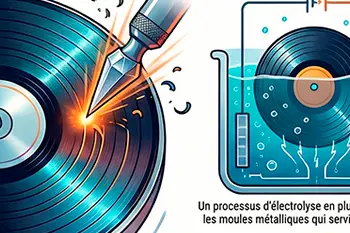
The cutting engineer works with a lathe fitted with a heated diamond stylus that traces the microgroove into a blank lacquer disc. The groove's undulations are not random — they geometrically reproduce the shape of the sound wave. A bass frequency swings the groove in wide, sweeping oscillations. A high frequency carves rapid, tightly packed ripples. The groove is a physical map of the sound.
Direct answer: How is sound stored on a vinyl record? Sound is stored as geometric variations in the walls of the microgroove. Each undulation corresponds precisely to a pressure variation in the original sound wave. It's a direct physical copy — analog, no digital conversion involved.
Why does vinyl sound "warm"?
It's the question everyone asks. And the answer lives in the physics of harmonics.
A real-world sound is never a single, pure frequency. When a bass string vibrates at 100 Hz, it simultaneously vibrates at 200 Hz, 300 Hz, 400 Hz — and beyond. These subtler, additional frequencies are called harmonics. They're what gives an instrument its character: a violin and a trumpet playing the same A note carry different harmonics, which is precisely why they don't sound the same.
Les harmoniques paires du vinyle
La chaîne analogique (cellule phono, préampli, tube ou transistor) introduit naturellement de légères distorsions. Ces distorsions s'expriment principalement sous forme d'harmoniques paires (2e, 4e harmonique). Par une curiosité de la perception humaine, ces harmoniques paires sont celles que l'oreille tolère le mieux et elle les perçoit comme de la "richesse", de la "rondeur", de la "chaleur".
Le numérique, lui, restitue le signal avec une précision quasi totale. Quand il sature, il génère des harmoniques impaires (3e, 5e), beaucoup plus agressives à l'oreille, c'est le "clipping" numérique, ce son dur et métallique qu'on entend sur un fichier trop compressé.
Vinyle - distorsion analogique
Génère des harmoniques paires (2e, 4e). L'oreille les perçoit comme de la chaleur, de la rondeur. C'est physiquement une imperfection, mais une imperfection qui plaît.
Numérique - précision totale
Restitue le signal original sans ajout. En cas de saturation, génère des harmoniques impaires (3e, 5e), perçues comme agressives. Plus "pur" sur le papier, mais moins flatteur à l'oreille.
Aucun des deux n'est "meilleur" dans l'absolu. L'un est plus fidèle, l'autre est plus chaleureux. C'est une question de goût autant que de physique.
Analogique vs Numérique : la différence fondamentale
Pour comprendre pourquoi le vinyle et le streaming ne jouent pas dans la même catégorie physique, voici la différence de base :
| Criteria | Analog sound (vinyl) | Digital sound (MP3, streaming) |
|---|---|---|
| Signal nature | Continuous, unbroken curve | Discrete, sampled at regular intervals |
| Resolution | Theoretically infinite (limited by the physical medium) | 44,100 samples/sec (CD), up to 192 kHz in hi-res |
| Degradation | Wears with each play, surface noise | No playback-related degradation |
| Saturation | Even harmonics (perceived as "warm") | Odd harmonics (perceived as "harsh") |
| Dynamic range | Constrained by the physical groove width | Very wide, but often sacrificed in mastering |
Playback: when plastic becomes music again
The loop closes at the turntable. The transduction chain runs in reverse — from the physical back to the acoustic.
The diamond stylus traces the microgroove's undulations and vibrates mechanically. The phono cartridge converts those vibrations into an electrical current. The phono preamp restores the frequency balance (via the RIAA curve). The amplifier raises the signal. And the speaker converts that electrical signal back into mechanical movement of its cone — which moves the air, which moves your eardrums.
Sound wave → Cut groove → Mechanical vibration → Electrical signal → Cone movement → Sound wave
A complete round trip between sound and matter. Not a single byte in sight. And it's precisely that 100% physical chain — imperfections included — that defines what we call the "warmth" of vinyl.
Frequently asked questions about the physics of sound
Frequently Asked Questions about Sound Physics
How do you define a sound wave in simple terms? ↓
A sound wave is a pressure variation travelling through air. When something vibrates, it compresses and releases the air molecules around it. Those variations travel to your ears, where your eardrums interpret them as sound.
How is sound stored on a vinyl record? ↓
Sound is cut into vinyl like a microscopic relief drawing. The groove — the spiral you can see on the record — isn't smooth: its walls undulate continuously, almost like a wave. Those undulations are a direct physical translation of the sound itself: when the sound is loud, the movements are wider; when it's high-pitched, the ripples are tighter; when it's low, they stretch out longer. As the stylus travels the groove, it follows these contours and vibrates in exactly the same way as the original sound wave. Those vibrations are then amplified — and become sound again. Vinyl is a direct, continuous copy of audio, with no numbers, no digital conversion: music transformed into motion, then carved into matter.
Why does vinyl sound "warmer" than digital? ↓
Vinyl naturally generates even harmonics (2nd, 4th) that subtly enrich the original signal. The human ear interprets these as a kind of "warmth" or "roundness." Digital, by contrast, reproduces the signal with total accuracy — no added harmonics — though it's entirely possible to introduce them artificially if you want to recreate that organic, analog character.
What is the difference between analog and digital sound? ↓
Analog sound is a continuous signal that mirrors the exact shape of the original wave. Digital sound is sampled: it captures 44,100 measurements per second (CD quality) and reconstructs the curve from those data points. Digital is more precise and doesn't degrade; analog is uninterrupted but accumulates imperfections and surface noise over time.
What frequency is a techno kick drum? ↓
A techno kick doesn't just get heard — it lives at the border of sub-bass and low frequencies, typically below 80 Hz. That's exactly where sound stops being something you listen to and becomes a physical experience you feel in your chest before it ever reaches your ears. Drop below 40 Hz and you're into infrasound territory — frequencies only a large subwoofer or a proper sound system can reproduce, the kind that makes the floor shake beneath you.
Further reading
Want to understand why vinyl sounds different from a digital file — and whether one is actually "better" than the other? We break down the debate in our next article.

See also