Vinyl vs Digital: Why Does Our Ear Prefer Imperfection?
Let's be honest from the start: on paper, digital wins. Better signal-to-noise ratio, no degradation on playback, near-perfect fidelity to the original master. On those technical metrics, a 24-bit WAV file beats vinyl hands down.
And yet millions of people still reach for a record. This isn't misplaced nostalgia: it's physics, psychoacoustics, and a little philosophy of listening.
Digital: the pursuit of absolute transparency
To understand vinyl's appeal, you first have to understand what digital does so well. And it really does it well.
A digital audio signal is a series of measurements taken at ultra-regular intervals: 44,100 times per second for a CD, up to 192,000 for high-resolution audio. These measurements, called samples, reconstruct the original sound curve with mathematical precision. The Nyquist-Shannon theorem guarantees that if you sample at more than twice the highest frequency you want to reproduce, you lose nothing audible. In plain terms: a CD at 44.1 kHz faithfully reproduces everything the human ear can hear.
What digital does better
Signal-to-noise ratio. This is the ratio between the useful sound and the parasitic background noise. A CD reaches around 96 dB. A good record sits around 60 to 70 dB. In practice: in the quietest passages, vinyl has an audible hiss where digital stays silent.
Dynamic range. In digital, the gap between the softest and the loudest sound can be huge with no distortion. In theory. In practice, the industry has often sacrificed that range at the mastering stage to make tracks sound "loud" on streaming platforms: the so-called loudness war. A well-mastered record can then end up with more real dynamics than an over-compressed CD, even though the digital format is theoretically capable of more.
Pure fidelity. What you hear is exactly what left the studio. No crackle, no hiss, no progressive wear. If the master is good, the digital file delivers it without betrayal.
Vinyl: the art of beautiful imperfection
So why does vinyl hold on? And hold on so well that global sales have climbed every year for over a decade? Because its "superiority" isn't decided on the field of measurement, but on the field of perception.
Warmth: a distortion that sounds right
What is "analog warmth"?
The addition of natural harmonic distortion that enriches the signal and makes it "rounder" to the ear. These are mostly even harmonics (2nd, 4th), generated by the whole analog chain: cartridge, preamp, transformers. How the wave is actually transformed in the groove is broken down in our deep dive into the physics of vinyl sound. Here, we're after a different question: why our ear prefers it.
The human ear is not a measuring instrument. It has preferences that have nothing to do with mathematical precision. One of them, well documented in psychoacoustics: it tolerates, even enjoys, even harmonics. Where digital clipping generates odd harmonics (3rd, 5th) heard as harsh and metallic, analog distortion produces even harmonics that sound "musical", almost like an enrichment of the timbre.
This isn't an illusion or a purist's excuse. It's measurable. Vinyl doesn't reproduce the original sound: it transforms it slightly. And millions of ears prefer that transformation.
The tiny imperfections that bring sound to life
A turntable isn't a perfect machine: its rotation speed varies ever so slightly. These tiny fluctuations (audiophiles call them wow and flutter) create a minute modulation in pitch.
On a good turntable we're talking 0.1 to 0.3 %: negligible on paper, but enough to give the impression that the sound "breathes". It's an imperfection, and it's also one of the reasons vinyl feels more alive than a file frozen in its 0s and 1s.
The ritual: listening better by making the effort
There's also something that isn't in the signal at all, but in your head. Putting on a record takes a gesture. Flipping the side is a conscious interruption. Reading the sleeve while you listen anchors you in the present. Studies in the psychology of listening show that the attention paid to an act increases perceived pleasure: the engagement effect. Vinyl forces you to be there. Streaming lets you drift.
That's not trivial for perceived quality. Sound listened to attentively, in the right setting, will always seem better than the same sound consumed distractedly on the move. Vinyl creates the conditions for good listening.
When digital imitates analog
Here's the most telling twist in the whole debate: today, sound engineers and producers actively work to put imperfection back into digital. And the plug-in industry hands them the tools to do it.
The plug-ins that imitate vinyl
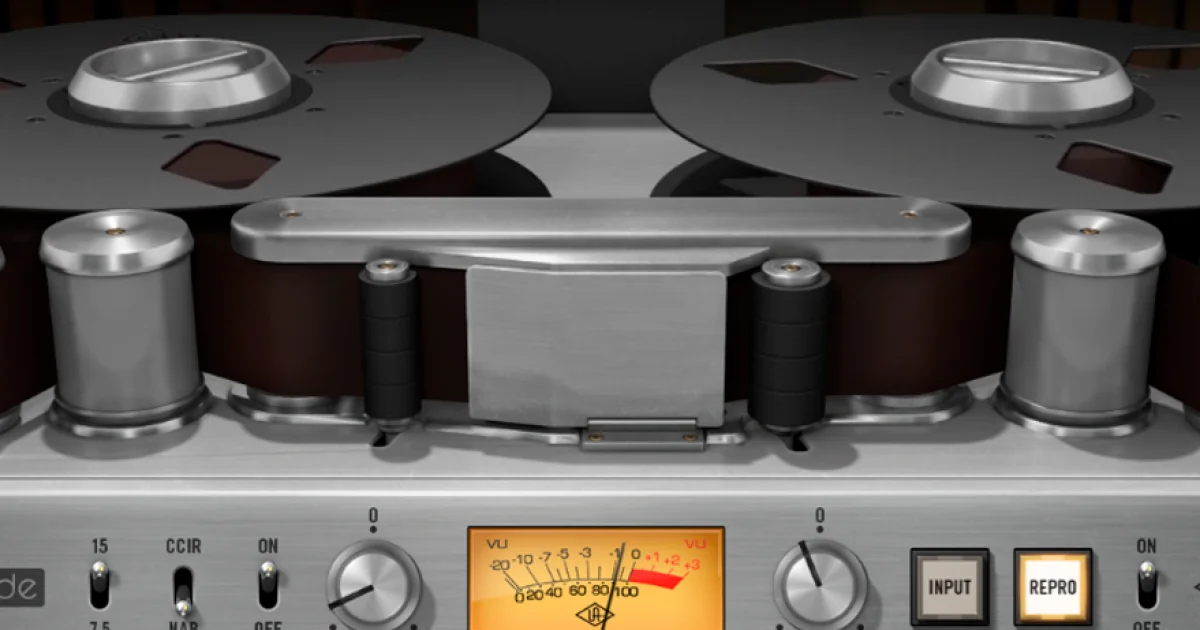
Tape saturation. Plug-ins emulate the behavior of a magnetic tape machine: gentle compression of transients, added even harmonics, a slight roll-off of the highs. The result sounds warmer, less sterile. Practically every professional electronic music mix runs through some form of analog saturation, even when it's fully digital.
Noise floor. Yes, some producers intentionally add hiss to their mixes. Perfect digital silence can sound cold, almost unsettling. A faint white or pink noise in the background creates a texture that makes the silence less brutal and the listening more comfortable.
Speed variations. Plug-ins recreate those micro-fluctuations in a turntable's speed to give digital sound that same sense of breathing. On pads, strings or sustained chords, the effect is instant: the sound suddenly feels organic where it was artificial.
What this tells us
If the audio industry pours millions into tools that imitate vinyl's flaws, then those flaws aren't bugs: they're musical features in their own right.
The special case of techno and hardtek
In hard electronic music, analog saturation isn't an option: it's a fundamental sonic color. The kick of a tribe record pressed at 45 rpm often has a thickness, an attack and a low-end resonance that a digital file struggles to match without serious post-production. It's not magic: it's the full analog chain, from cutting and pressing to the cartridge and preamp, adding its own little layer of harmonic saturation at every step.
Producers around old-school tribe and hardtek labels figured this out long ago: pressing to vinyl also means running the master through a natural analog treatment that gives it its final character. From there it depends on the track and the ear doing the listening, but for many it's no manufacturing defect: it's the sound.
If you want to judge for yourself, VinylBleu's hardtek and tribe vinyls are there for exactly that, and you'll hear the difference with an equivalent digital file straight away.
The real numbers, side by side
| Criterion | Vinyl | Digital (CD / HD) |
|---|---|---|
| Signal-to-noise ratio | ~60 to 70 dB | >96 dB (CD), >120 dB (HD) |
| Dynamic range | ~65 to 70 dB (limited by the groove) | ~96 dB, often sacrificed at mastering |
| Harmonic distortion | 0.1 to 1 % (even harmonics, pleasant) | <0.01 % (near zero, odd if clipping) |
| Wear over time | Progressive (scratches, groove wear) | None from playback |
| Sonic character | Warm, round, "alive" | Precise, transparent, "cold" to some |
| Portability | Low | Total |
Frequently asked questions
What is analog warmth? ↓
The addition of natural harmonic distortion that enriches the signal and makes it "rounder" to the ear. These distortions, mainly even harmonics (2nd, 4th), are generated by the entire analog chain and perceived as pleasant, unlike the odd harmonics of digital clipping.
Is vinyl better than streaming? ↓
Only on a level playing field. A lot of the differences you hear come not from the format but from the source: streaming compressed at a low bitrate by the platform, or a track that's badly mixed with no real mastering, will sound bad on any medium. To compare honestly you need the same artist, the same track, the same master, on good-quality streaming. Under those conditions digital stays technically more precise, but vinyl adds an analog character that many people prefer.
Why do people imitate the vinyl sound in digital? ↓
Because analog imperfections have real musical value. Plug-ins reproduce tape saturation, noise floor and a turntable's micro speed variations to give digital back the "life" of analog. If we try to imitate vinyl, it's because it holds something digital precision doesn't capture on its own.
Does techno sound better on vinyl? ↓
It depends on who's judging and how. It's partly a matter of taste: the analog chain adds a harmonic saturation that thickens the kick and the bass, and many fans love it. But "better" stays subjective and also depends on the track and its production. It's not an absolute superiority, it's a sonic color you either like or you don't.
Choose for the moment
The real answer isn't "one is better than the other", it's "which one for what, when, and why". Digital is the tool of the studio, of mobility, of precision. Vinyl is the tool of immersion, of collecting, of character. It's not choosing between the past and the future: it's choosing between two ways of listening. And having both never hurt anyone.
Further reading